

AI local search optimization for article intros
Key Takeaways (Notice What We Are Doing Here)
See how this section appears immediately after the headline? That’s the framework we’re sharing in this article. Why? Here’s a breakdown:
- The Problem: AI systems have about a 300-word crawl budget. If your key information isn’t in the first third of your page, you’re likely invisible to ChatGPT, Google AI Overviews, and Perplexity.
- The Research: WordStream found 38% higher AI citation rates when pages front-load essential information in the first 200 words.
- What’s Killing You: Long introductions, buried answers, popups, slow load times, and no clear entities upfront.
- The Fix: Restructure your opening 300 words to answer immediately—then provide your comprehensive detail.
This takeaway section models exactly what your service pages need: complete answer upfront, entities clear, then elaboration below. Let’s dig into why this matters.
Why Your Article’s First 300 Words Determine Everything in AI Search
You did everything right.
Hired an SEO agency. Published comprehensive content. Maybe you’re even ranking #1 for your target keywords. Your website loads beautifully. Your pages answer every possible customer question in meticulous detail.
Yet ChatGPT never mentions you. Google’s AI Overview skips you entirely. Perplexity recommends your competitor down the street.
What the hell happened?
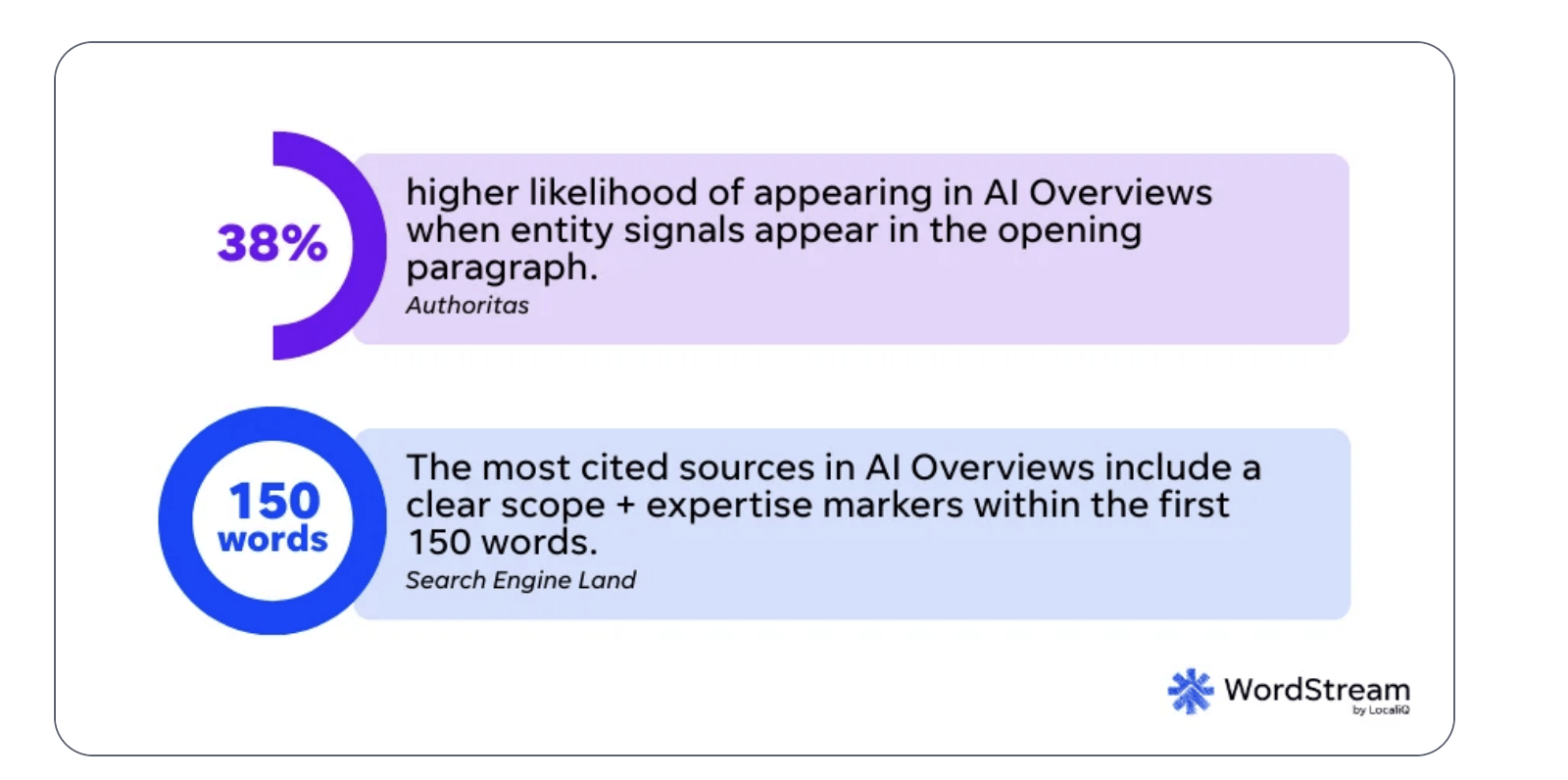
Source: Wordstream: Why Your First 200 Words Are Crucial for AI Optimization
The Game Changed (And Nobody Told You)
Here’s the brutal truth: AI systems have a crawl budget of approximately 300 words.
That’s it. The first third of your page. If your essential information—who you are, what you do, where you serve, why you’re qualified—isn’t within that first 300-word window, your page is rendered basically useless for AI search.
Everything you wrote after that? Doesn’t exist to AI.
WordStream just published research confirming this: pages with key information in the first 200 words saw a 38% higher likelihood of AI citations. Translation: if AI can’t extract your value in the opening, you don’t exist in the new search paradigm.
Why Your “Good SEO” Is Killing Your AI Visibility
Traditional SEO taught us to:
- Build suspense with engaging introductions
- Provide comprehensive, detailed explanations
- Structure content for readability (humans scroll)
- Use storytelling to hook readers
That advice just made you invisible to AI.
Here’s what’s probably happening on your pages right now:
The Long, Beautiful Introduction (That Wastes Your Crawl Budget)
“When it comes to plumbing services in the greater Seattle area, homeowners have many options to consider. Choosing the right plumber can make all the difference in ensuring your home’s systems function properly and efficiently. With over three decades of combined experience, our team understands the unique challenges that Pacific Northwest weather presents for residential plumbing…”
Word count to actual answer: 200+ words
AI assessment: Floating text, no extractable value, moving on
The Buried Answer (AI Never Gets There)
Your answer about 24/7 emergency service? It’s in paragraph four, at word 487.
AI’s crawl budget ran out at word 300.
Your competitor put “24/7 Emergency Plumbing – Seattle” in word 12.
Guess who ChatGPT recommends?
Technical Sabotage You Don’t See
Even if your content structure is decent, these technical issues kill AI crawlers before they start:
- Newsletter popup at 3 seconds: AI extraction fails, moves to next result
- 8-second load time: AI timeout threshold exceeded
- No lazy loading on images: Full page weight slams crawl budget
- Bulky legacy code: AI parser can’t efficiently extract
- No clear entities upfront: “Floating text” problem—nothing to attribute
You might rank page 1 in traditional Google. AI systems bail on second 1.
What AI Systems Actually Need (The First 300 Words)
3 Core Signals for AI Local Search Optimization for Article Intros

AI crawlers make citation decisions in milliseconds. They need three core signals immediately:
1. Intent Match: What query does this answer?
2. Expertise Markers: Who is this and why should I trust them?
3. Context Entities: Where, when, what specific service?
Easy AI Local Search Optimization for Article Intro Transformation
Here’s what this looks like in practice:
❌ Traditional SEO Structure (AI-Invisible):
H1: Seattle Plumbing Services

Introduction about importance of plumbing... history of company... values and mission... customer service philosophy...

[300 words later]

"We offer emergency plumbing services..."
AI sees: Generic intro, no entities, no answer. Next.
✅ AI-Optimized Structure (Gets Citations):
H1: 24/7 Emergency Plumbing Services Seattle

Summary: [Business Name] provides 24/7 emergency plumbing repair across Seattle and King County. Licensed Master Plumber [Name] responds within 60 minutes for burst pipes, water heater failures, and sewer backups. Serving residential and commercial properties since [year].

[Then elaborate with detail]
AI sees: Clear intent match, credentialed expert, specific service area and offering. ✓ Citation worthy.
The Crawl Budget Reality Check
Think of AI crawlers like this:
Traditional Google: Reads your entire page, indexes everything, considers hundreds of ranking factors over time
AI Systems: Get 300 words to make a citation decision, then they’re gone
It’s not about depth anymore. It’s about extraction speed.
Your 2,000-word comprehensive guide loses to a 400-word page that front-loads the answer—every single time.
Audit Your Content Right Now
Open your most important service page. Count words from H1 (or the title) to where you actually answer:
- What you do
- Who you are
- Where you serve
- Why you’re qualified
If that’s past word 300: You’re invisible to AI.
The Fix Is Simpler Than You Think
You don’t need to rewrite everything. You need to restructure your opening.
The AI Local Search Optimization Framework for Article Intros:
- H1: Clear service + location (entities AI can extract)
- Summary paragraph: Complete answer with all key entities
- Then: All your beautiful detail and comprehensive content
Example transformation:
Before:
“Quality matters when selecting a contractor…” (goes on for 250 words)
After:
“[Business Name] provides licensed general contracting services across Whatcom County, specializing in kitchen remodels, bathroom renovations, and home additions. Contractor [Name] holds Washington State L&I license #[number] with 15 years residential construction experience.”
Then your story about why quality matters.
Same content. Reordered for AI extraction. Now you exist in AI search.
Why This Matters More Than Traditional Rankings
Here’s what changed: AI search is winner-takes-all.
Traditional Google shows 10 blue links. Users might click several.
ChatGPT recommends 1-3 businesses. Google AI Overview highlights 1-2. Perplexity gives a single answer.
You’re either the recommendation or you don’t exist.
And that recommendation decision? Made in your first 300 words.
Stop Optimizing for Humans (Only)
I know this feels wrong. Good writing builds up to the answer. Storytelling creates engagement. Long-form comprehensive content establishes authority.
All true. All still matters.
But now you need to write for two audiences:
AI Systems (First 300 words): Direct answer, clear entities, extractable value
Human Readers (Remaining content): Story, detail, personality, depth
Think of it as a newspaper article structure: lead paragraph gives you the whole story, rest provides context and detail.
AI reads the lead. Humans who care read everything.
AI local search optimization for article intros: The Bottom Line
You invested in good SEO. You created quality content. You’re probably ranking well.
But if AI can’t extract your value in the first third of your page, you’ve rendered that investment useless for the future of search.
The good news? This is fixable. You don’t need new content—you need restructured openings.
The bad news? Every day you wait, AI systems are citing your competitors instead of you.
Your page 1 ranking won’t save you when customers never see your business mentioned.


