

New research published today reveals exactly what makes AI engines name-drop one business and ghost the rest. Here’s the Invisible Checklist.
You built a good business. Your reviews are solid. Your website exists. But the phone isn’t ringing the way it used to.
Here’s why: AI is doing the recommending now. And AI doesn’t show your customer a list of ten options anymore. It picks one. It name-drops that business by name and sends the customer straight there. If it’s not you, you’re invisible — and you’d never know.
That’s the ghosting problem. And until today, most of what we knew about how AI decides who to recommend was guesswork, hot takes, and a few decent experiments.
Then Cyrus Shepard published AI Citation Ranking Factors — an evidence-based analysis of 54 separate experiments, studies, and patents on how AI engines like ChatGPT, Gemini, Perplexity, and Google’s AI Overviews decide who gets cited. Who gets the name-drop. Who becomes AI-Famous.
Why this matters more than your gut tells you
Before we get into the factors, here’s the stat that should make every local business owner sit up: a recent study from Seer Interactive found that getting cited in Google’s AI Overviews drives 120% more organic clicks per impression and 41% more paid clicks compared to brands that aren’t cited.
That’s not a small lift. That’s the difference between your phone ringing and your competitor’s phone ringing.
AI citations aren’t a vanity metric. They’re how customers actually reach you now.
The 6 factors that matter most for local businesses
Cyrus identified 23 factors total. Six of them matter most for local businesses trying to get name-dropped by AI. Here they are in plain English.
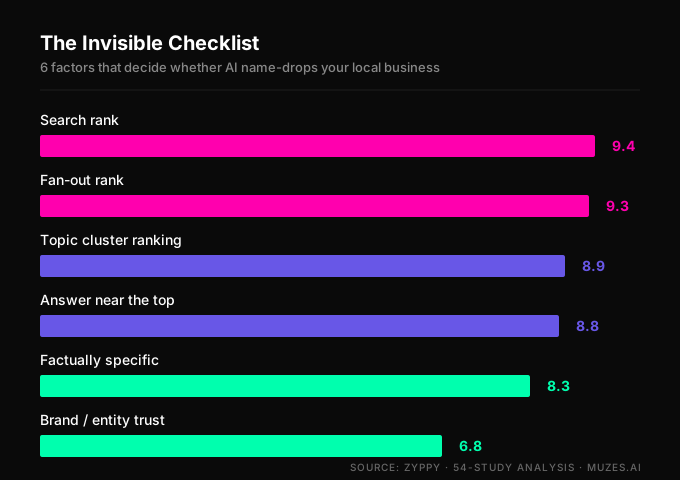
1. Search Rank — If you’re not on page one, AI probably won’t cite you
The research: Ahrefs found 38% of AI Overviews citations come from the top 10 Google results. Drop below that and your odds collapse fast.
Translation: Traditional ranking didn’t die. It became the ticket to the AI conversation. If you’re not on page one of Google for what your customers are searching, AI engines are probably not putting you on their shortlist either.
Why local biz can win: Local search has a much smaller competitive pool than national. Ranking page one for “plumber in Bellingham” is a winnable fight. Ranking page one for “plumber” is not.
2. Fan-out Rank — AI asks 15-20 hidden questions you’ve never heard
The research: When a customer asks an AI a question, the AI quietly fires off a fan of related searches behind the scenes — sometimes 15 or 20 of them — to ground its answer. The studies show a strong relationship between ranking for those hidden fan-out queries and getting cited.
Translation: A customer asks “best HVAC company in Tacoma.” The AI also runs hidden searches for things like “HVAC repair Tacoma,” “emergency furnace Tacoma,” “AC installation cost Tacoma,” “HVAC reviews Tacoma,” and a dozen more. If you don’t show up for those hidden searches, you don’t get the name-drop.
Why local biz can win: A few well-built service pages, location pages, and FAQs covering the questions your real customers actually ask can knock out a huge chunk of fan-out queries. National brands can’t be that specific to your city. You can.
3. Topic Cluster Ranking — One page about your service is not enough
The research: Ranking for many related queries — not just one — dramatically increases your odds of being cited at least once.
Translation: AI doesn’t reward the business with one well-optimized homepage. It rewards the business that proves comprehensive expertise across every topic in their field. Plumbing covers water heaters, leak detection, repiping, drain cleaning, sewer lines, fixtures, emergency calls, and on and on. If your site only talks about “plumbing services,” AI sees a thin operator.
Why local biz can win: You actually do all those things. You just haven’t put it on the website yet. The expertise is already in your head.
4. Answer Near the Top — AI doesn’t read your whole page
The research: Dan Petrovic showed that Google’s Gemini uses a strict retrieval cap per URL. Content near the top of the page is far more likely to make the cut. Multiple other studies back this up.
Translation: Burying your answer halfway down the page kills your chances. If someone asks “do you do same-day water heater replacement in Bellingham,” the answer needs to be at the top of the page — not after three paragraphs about your company history.
Why local biz can win: This is a writing fix, not a budget fix. Lead with the answer. Save the company story for further down.
5. Factually Specific — “We do great work” is not citable
The research: Pages that showcase specific, verifiable facts get cited more often than pages with vague claims.
Translation: AI engines need something concrete to cite. “We’re the best plumbers in town” is unciteable. “We’ve replaced over 1,200 water heaters across Whatcom County since 2019, with most jobs completed same-day” is exactly the kind of statement AI can attach to an answer.
Why local biz can win: You have the specifics. Years in business. Service area cities. Number of jobs. Response time. License numbers. Brands you service. Most local sites just don’t put them on the page.
6. Brand / Entity Trust — Does AI even know you exist?
The research: AI engines increasingly favor sources they recognize and trust. What they already know about a brand influences whether they seek it out for citations.
Translation: AI builds a mental model of who’s who in every niche, every city. The Mayo Clinic for medical questions. The local plumber it’s seen mentioned across reviews, citations, articles, the GBP profile, and consistent web presence — that’s who it cites.
Why local biz can win: Building entity trust at the local level is far easier than at the national level. You don’t need to be famous everywhere. You need to be famous in your service area.
The local advantage is real
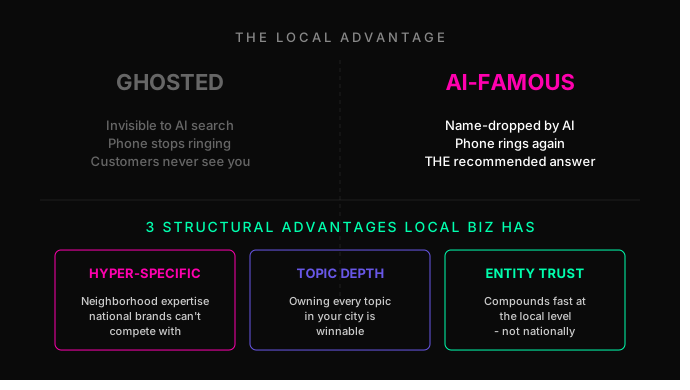
Here’s what jumped out reading all 54 studies: nothing on this list favors big national brands over local ones. If anything, the opposite.
Local businesses have structural advantages in three of the most important factors:
- Hyper-specific neighborhood expertise is exactly the kind of factually specific, self-contained content AI rewards. National brands can’t be hyperlocal. You are.
- Topic depth at the city level is winnable. Owning every plumbing topic in Bellingham is achievable. Owning every plumbing topic in America is not.
- Entity trust at the local level compounds fast. A handful of consistent signals — accurate GBP, consistent NAP across citations, real reviews, content that matches — and you become the recommended option in your market.
The catch: almost nobody is doing this work yet. Which is exactly why this window is wide open.
What this validates about AI Local SEO
Here’s the part we want to be straight about. We’ve been telling local business owners this for a while:
AI doesn’t rank you. AI recommends you. And to get recommended, you need comprehensive topical authority — not a few well-optimized pages, not a stack of backlinks, not a citation cleanup. You need to prove you’re THE expert across every topic that matters in your market.
54 studies just put receipts behind that. The Invisible Checklist isn’t theory. It’s what the data shows AI engines actually do.
Cyrus’s TL;DR sums it up: win SEO, win AI citations — with a few extra steps. Those extra steps are exactly the work we do at Muzes AI.
We feed AI the right script — comprehensive topic coverage, answers placed near the top, factually specific passages, entity-consistent signals across the web — so when your customer asks, AI knows exactly who to recommend.
Stop getting ghosted
If you’re a local business owner reading this and wondering whether AI is sending your customers somewhere else, the honest answer is: probably yes, on at least some queries, right now.
The Invisible Checklist is real. The fix is real. And the businesses that work through it in the next six months will own their markets for years.
We hate being ghosted. We bet you do too.


