

AI-Powered Local Packs: Key Takeaways
- Traditional rankings no longer guarantee visibility in AI-powered results
- AI systems evaluate businesses using different criteria than conventional search algorithms
- The “winner takes all” model: AI packs show 1-2 businesses vs. traditional 3-pack format
- 44% of mobile searches now display AI-powered local packs instead of traditional 3-packs
- 70% of businesses shown in AI packs are completely different from traditional map pack results
- High-intent shopping queries (“best,” “affordable,” “free consultation”) trigger AI packs 100% of the time
44% of mobile searches now show AI-powered results that recommend completely different businesses than traditional map packs.
You’re ranking #1 in the local map pack. Your reviews are stellar. Your website is optimized. Yet somehow, your leads are declining.
Here’s what’s happening: 44% of mobile searches now show AI-powered local packs instead of traditional map packs – and they’re recommending completely different businesses than the ones ranking in traditional search results.
If you’re not showing up in these AI-powered results, you’re invisible to nearly half your mobile traffic. And here’s the kicker: these AI packs are appearing for your highest-value search queries – the ones from customers ready to buy.
Let me show you exactly what’s changed, why it matters, and how to optimize your business for both human users and AI systems.
What Are AI-Powered Local Packs?
AI-powered local packs are Google’s new format for displaying local business recommendations. Instead of showing the traditional “3-pack” (three businesses with a map), Google now uses AI to generate customized recommendations based on what it thinks best matches the searcher’s intent.

Here’s how they’re different:
Traditional Local Pack:
- Shows exactly 3 businesses
- Includes a map with pins
- Based primarily on proximity, relevance, and prominence
- Consistent results for similar queries
- Appears on both desktop and mobile
AI-Powered Local Pack:
- Shows 1-2 businesses initially (expandable)
- May or may not include a map
- Based on AI’s interpretation of intent and quality signals
- Results vary even for identical queries
- Currently mobile-only in the United States
The most alarming difference? Approximately 70% of the businesses shown in AI packs are completely different from those appearing in traditional map packs, according to research from Juri Digital.
This means your traditional map pack ranking is no guarantee you’ll appear in AI-powered results.
The Data Every Small Business Owner Needs to See
Recent research analyzing legal searches revealed some eye-opening statistics that apply across industries:
Mobile Search Reality
44% of commercial-intent mobile searches now display AI-powered map packs instead of traditional 3-packs. That’s nearly half of your mobile traffic encountering a completely different search result format.
70% of businesses shown in AI map packs are different from those in traditional map packs – not just reordered, but entirely different businesses getting recommended.
Desktop Isn’t Safe Either
On desktop, AI Overviews appear 55% of the time for commercial searches. And here’s the real problem: 77% of those AI Overviews recommend completely different businesses than what appears in the traditional map pack below them.
Since AI Overviews appear ABOVE the map pack, they’re stealing clicks from businesses that spent years optimizing for traditional local SEO.
Query Modifiers Matter More Than Ever
The research revealed which search terms trigger AI packs vs traditional packs – and the pattern is striking:
AI Map Packs Triggered 100% of the Time:
- “Affordable [service] [city]”
- “Best [service] [city]”
AI Map Packs Triggered 75% of the Time:
- “Free consultation [service] [city]”
Traditional Packs Still Dominate:
- “[Service] + [city]” (0% AI packs)
- “[Service] near me” (0% AI packs)
What this means: High-intent shoppers using decision-making language (“best,” “affordable,” “free consultation”) are seeing AI packs. Basic location searches still show traditional results.
You’re losing your highest-value traffic to AI-powered results you’re not optimized for.
AI Overviews appear 55% of the time for commercial searches
Why Traditional SEO Isn’t Enough Anymore
Let me be clear: traditional SEO still matters. Keywords, rankings, backlinks, citations – none of that became obsolete overnight.
But here’s the truth: traditional SEO now gets you IN THE ROOM. AI optimization gets you THE BUSINESS.
The “Winner Takes All” Reality
Traditional 3-packs showed three businesses. AI packs show 1-2 before the “more” expansion. That’s a 68% reduction in immediate visibility.
And since 70% of AI pack businesses are different from traditional pack rankings, being #1 in the old game doesn’t help you in the new one.
What Actually Determines AI Pack Visibility?
AI systems don’t just look at your traditional ranking factors. They’re evaluating:
Entity clarity: Can AI confidently identify who you are, where you are, and what you do?
Semantic signals: Does your business explicitly match the intent modifiers people use (“affordable,” “best,” “emergency”)?
Cross-platform consistency: Does AI see the same information about you everywhere it looks?
Extractable information: Is your content structured so AI can parse and cite it?
Authority AI trusts: Not just any backlink – mentions on platforms AI actively crawls and trusts.
Review quality over quantity: Descriptive, recent reviews that provide semantic context about what you offer and who you serve.
The Attribution Black Hole
Here’s an emerging problem most businesses haven’t noticed yet: When AI recommends your business, some results provide no click to track.
A customer asks Google AI Mode or ChatGPT for a restaurant recommendation. AI suggests your restaurant. Customer calls or shows up. You got a customer – but have no idea it came from AI search.
This is what industry experts are calling “invisible demand” – customers arriving through channels you can’t attribute or optimize for because you don’t know they exist.
Sound SEO Engineering in 2026: Optimizing for AX and UX
The solution isn’t to abandon traditional SEO. It’s to evolve how you execute it.
Sound SEO engineering now means optimizing for two audiences simultaneously:
- UX (User Experience): Human visitors who need to convert
- AX (Agent Experience): AI systems that need to understand and recommend you
This isn’t a fifth pillar of SEO – it’s a lens through which you execute the four pillars that have always mattered.
1. Technical SEO (AI-Enhanced)
For humans:
- Fast load times
- Mobile-responsive design
- Clean navigation
- Secure connection (HTTPS)
For AI systems:
- Schema markup (helps AI extract entity data)
- Structured data (AI can parse relationships)
- Clean HTML structure
- Crawlable architecture for AI bots
The fusion: A technically sound foundation serves both audiences. Your schema markup helps Google display rich snippets for humans while simultaneously helping AI systems understand your business entity.
Example: Local Business schema with proper foundingDate, address, priceRange, and areaServed fields helps both Google’s traditional algorithm AND its AI systems understand exactly what you offer and where.
2. Authority Signals (AI-Enhanced)
For humans:
- Reviews build trust
- Testimonials provide social proof
- Brand mentions establish credibility
- Awards and certifications validate expertise
For AI systems:
- Descriptive reviews (AI extracts semantic context)
- Cross-platform mentions (AI verifies your entity across sources)
- Citations on sites AI actively crawls
- Consistent information AI can validate
The fusion: Authority that humans trust AND AI can verify independently.
Example: A review that says “Best HVAC service in Seattle – they came out same day and fixed our furnace for way less than we expected” gives AI multiple extractable signals: location (Seattle), service type (HVAC), speed (same day), and positioning (affordable).
3. Content (AI-Enhanced)
For humans:
- Readable and engaging
- Conversational tone
- Scannable with headers and bullets
- Answers questions clearly
For AI systems:
- Semantic triples (entity-attribute-relationship statements)
- Extractable structure
- Explicit rather than implied meaning
- Query intent alignment
The fusion: Content humans enjoy reading that AI can extract and cite.
Example of dual-optimized content:
“Smith Plumbing is a licensed, affordable emergency plumbing service serving residential and commercial customers throughout greater Seattle. We provide 24/7 same-day service for burst pipes, water heater failures, and drain emergencies.”
What humans see: Clear, readable introduction that tells them what you do and where.
What AI extracts: [Smith Plumbing] is [licensed] [affordable] [emergency plumbing service] serving [residential + commercial] [Seattle area] offering [24/7 same-day service] for [burst pipes, water heaters, drains].
4. User Experience (AI-Enhanced)
For humans:
- Intuitive navigation
- Clear calls-to-action
- Easy-to-find contact information
- Conversion-focused design
For AI systems:
- Clear information hierarchy
- Explicit service descriptions
- Obvious contact methods AI can extract
- Structured pricing information
The fusion: An experience that converts humans while giving AI the clear signals it needs to recommend you confidently.
Example: A services page that lists “Free Consultation | Same-Day Service | Licensed & Insured” serves both audiences. Humans quickly see your value props. AI extracts clear attributes it can match against search queries.
How to Optimize Your Business for AI Pack Visibility
Now let’s get tactical. Here’s what you need to do:
Step 1: Optimize Your Google Business Profile
Your GBP is often the first place AI systems look for information about your business.
Add services that match AI pack triggers:
- “Free Consultation” (triggers AI packs 75% of the time)
- “Affordable [Your Service]” (triggers 100%)
- “Best-in-Class [Service]” or “Premium [Service]” (matches “best” queries)
- “Emergency [Service]” (for service industries)
- “Same-Day Service” (signals speed/availability)
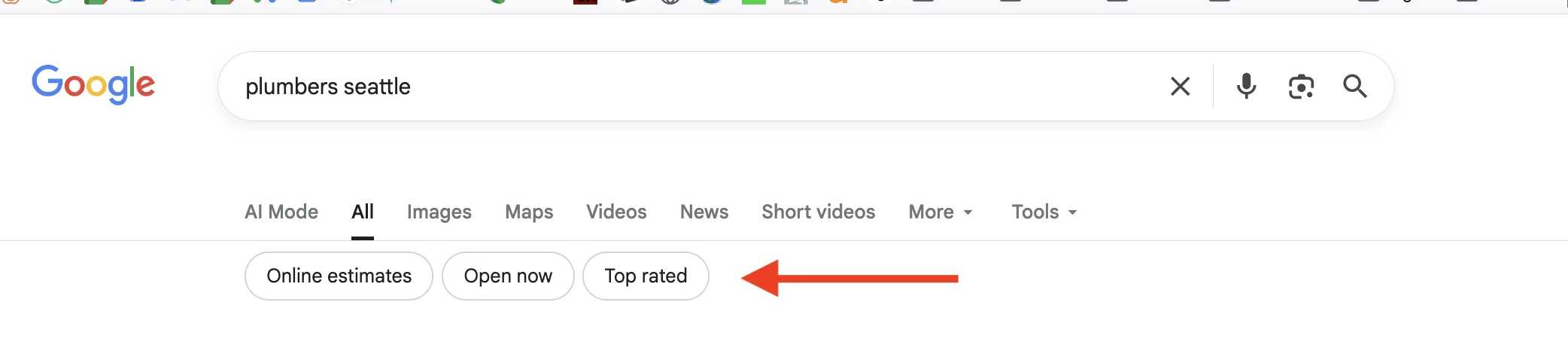
Update your business description to include positioning signals:
Instead of: “We are a plumbing company serving the greater Seattle area.”
Write: “Licensed Plumbing is an affordable, 24/7 emergency plumbing service serving homeowners and businesses throughout greater Seattle and King County. We offer free estimates and same-day service for all plumbing emergencies.”
Set your price level accurately: If you’re competing on value, make sure your price level ($$ vs $$$$) reflects that.
Step 2: Add Entity Disambiguation to Your Website
If your business name could be confused with others (especially if you acquired a domain with history), add a clear disambiguation statement.
Example footer text: “Muzes AI (est. 2026) is a Bellingham, Washington-based AI Local SEO agency founded by Daniella Simon, serving small businesses throughout Western Washington and nationwide. Not affiliated with any UK-based businesses using similar names.”
This helps AI systems understand you’re a distinct entity.
Step 3: Structure Your Content for AI Extraction
Every major page should include semantic triple statements early:
Homepage: “[Business Name] is a [positioning attribute] [service type] serving [location/audience]. We help [target customer] with [specific problems/services].”
Service pages: Lead with clear, extractable descriptions of what you offer, who it’s for, and why you’re different.
Use question-format H2 headers that match how people actually ask AI:
- “What makes us different from other [service providers]?”
- “Do you offer emergency/same-day service?”
- “How much does [service] cost in [location]?”
Step 4: Build Cross-Platform Consistency
AI systems verify information across multiple sources. Inconsistency creates doubt.
Ensure exact NAP consistency:
- Google Business Profile
- Website (footer and contact page)
- Major citations (Yelp, Better Business Bureau, etc.)
- Social media profiles
- Industry directories
Match your positioning language: If you’re “affordable” on your website, use “affordable” (not “budget-friendly” or “economical”) in your GBP services and citations too.
Step 5: Encourage Descriptive Reviews
Generic 5-star reviews don’t give AI much to work with. Descriptive reviews do.
Instead of: “Great service!”
Encourage: “Great HVAC service – they came out same day to fix our broken furnace. Very affordable compared to the other quotes we got. Highly recommend for emergency heating repairs in Seattle.”
This review gives AI extractable signals about services offered (HVAC, heating repair), speed (same-day), positioning (affordable), and location (Seattle).
Real-World Case Study: Fixing Entity Confusion in Under 60 Minutes
Let me share a recent example that proves semantic optimization works fast.
When I launched Muzes AI, I acquired a domain that had previously been used by a London-based business. When I tested “best local SEO Bellingham” in Google’s AI Mode, it showed my business – but tagged to LONDON instead of Bellingham, Washington.
The fix required three strategic moves:
- Used Google Local Guide status to edit the old London GBP – marked it permanently closed and changed its category to differentiate it
- Added a clear disambiguation statement to my website footer – explicitly stating Muzes AI is a Bellingham, WA business founded in 2026, not affiliated with any UK businesses
- Submitted updated information to a data aggregator – ensuring clean NAP propagation across citation sources
Result: Less than 60 minutes later, the London location was completely gone from AI search results. AI Mode now correctly identifies and recommends my Bellingham-based business.
This proved two critical points:
- AI search can be optimized – it’s not some unpredictable black box
- Results show up fast – we’re talking hours, not months
The key was understanding what AI systems needed: clear, consistent, verifiable entity information structured for extraction.
Testing and Monitoring Your AI Visibility
You can’t optimize what you don’t measure. Here’s how to track your AI pack visibility:
Monthly Testing Protocol
Test these search patterns:
- “[Your service] [your city]” – baseline traditional search
- “Best [your service] [your city]” – AI pack trigger
- “Affordable [your service] [your city]” – AI pack trigger
- “Free consultation [your service] [your city]” – AI pack trigger
Check multiple surfaces:
- Traditional Google search (desktop and mobile)
- Google AI Mode (available in search filters)
- AI Overview boxes (appear automatically on some searches)
Document your findings:
- Which queries trigger AI packs vs traditional packs?
- Do you appear in AI-powered results?
- Which competitors are showing up?
- What language/positioning do they use?
What to Track
Immediate metrics:
- Presence in AI packs (yes/no)
- Position when present (1st, 2nd, or “show more”)
- Query types that trigger your appearance
Longer-term metrics:
- Phone calls and form submissions (overall trends)
- “How did you hear about us?” responses (watch for “Google search” or “looked you up online”)
- New customer acquisition costs
Timeline Expectations
Technical fixes (schema, entity disambiguation): Hours to days for AI systems to recognize
Content and positioning updates: 2-4 weeks for full propagation
Citation and authority building: 4-8 weeks to see impact
Brand signal strength: 3-6 months for new businesses
Be patient but persistent. AI search is evolving rapidly, but the fundamentals of clear entity definition and semantic optimization remain constant.
The 5% of Agencies That Understand This
Here’s the uncomfortable truth: Most marketing agencies are still operating with a 2020 playbook.
They’re focused exclusively on traditional ranking factors because that’s what they know. They’re either ignoring AI search entirely (“wait and see”) or panicking about it (“nothing works anymore!”).
Both approaches leave their clients vulnerable.
The agencies that succeed in 2026 and beyond will be the ones that understand: sound SEO engineering now means optimizing for both user experience (UX) and agent experience (AX).
It’s not throwing out everything that worked. It’s executing the same foundational principles – technical excellence, authority building, quality content, great user experience – with an additional lens: Can AI systems understand, extract, and recommend this business?
The businesses that adapt early have a massive advantage. While 95% of their competitors are still optimizing only for traditional search, they’re capturing the 44% of mobile traffic seeing AI-powered results.
What This Means for Your Business
If you’re reading this and feeling overwhelmed, take a breath. You don’t need to rebuild your entire online presence overnight.
Start with these three priorities:
- Audit your Google Business Profile – Add services that match AI pack triggers (“Free Consultation,” “Affordable [Service],” “Best-in-Class [Service]”)
- Add entity clarity to your website – Update your homepage and about page to include clear semantic triple statements about who you are, what you offer, and where you serve
- Test your AI visibility – Search for “[best/affordable] [your service] [your city]” and see what comes up. If you’re not there, now you know why.
The shift to AI-powered search isn’t coming – it’s here. 44% of mobile searches. 70% different businesses. Query modifiers that determine who gets seen and who stays invisible.
The question isn’t whether to optimize for AI search. The question is: Can you afford not to?
Your competitors are already losing leads to businesses they outrank in traditional search. Don’t let that be you.
Ready to Own Your Local Market in the AI Search Era?
At Muzes AI, we help small businesses navigate the transition from traditional SEO to AI-optimized search visibility. We combine Wall Street-grade AI search methodology with Main Street pricing designed for small business budgets.
Schedule a free 30-minute consultation to assess your current AI search visibility and get a roadmap for semantic optimization tailored to your business.


