Personal Injury Law Firm AI Slop
The evidence has been collected. The case is overwhelming. And frankly, the defense has no leg to stand on. 31% of legal professionals now personally use generative AI for work — up from 27% the year before. Most of it goes straight to content with minimal oversight. Source: Legal Industry Report 2025 — American Bar Association
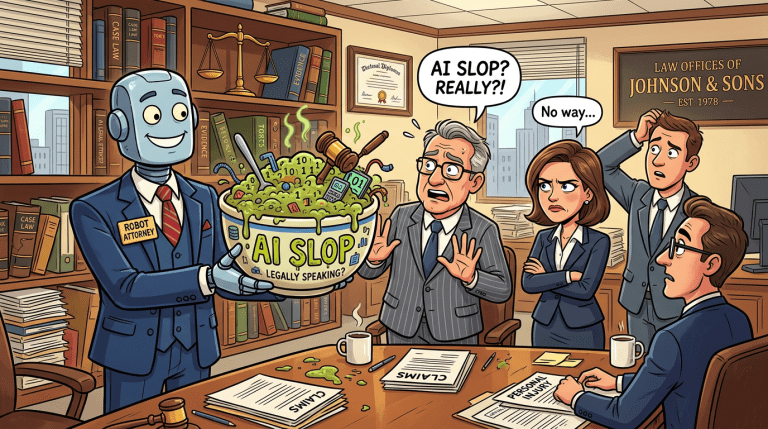
Personal injury law firms are among the most prolific publishers of AI slop on the internet. The charges are serious: thousands of practice area pages that sound identical, blog posts that say nothing, city pages that swap one location name for another and call it content. Websites that look expensive but read like they were written by a paralegal who delegated to a robot who delegated to no one.
Your clients are people who just had the worst day of their lives. They got hit by a drunk driver on I-5. Their employer ignored a safety violation. They lost someone. They are sitting in a hospital waiting room or a car in a parking lot at midnight searching for someone they can trust with everything.
And your website opens with: “If you have been injured due to the negligence of another party, you may be entitled to compensation. Our experienced team of personal injury attorneys is committed to fighting for your rights.”
Every. Single. Firm.
The AI wrote it. Nobody edited it. It went live. Case closed.
Exhibit A: What PI Firm AI Slop Actually Looks Like
AI slop in personal injury law has a specific signature. You know it when you see it because it covers everything and says nothing. It uses words like “aggressive representation” and “maximum compensation” and “dedicated to justice” without ever telling a potential client what working with your firm actually feels like, what your process looks like, or why you specifically are the right choice for their specific situation.
It is content written for search engines that existed five years ago. It is not written for a scared person making a high-stakes decision at the worst moment of their life. And it is absolutely not written for the AI systems that are now deciding which firms to recommend.
The Double Verdict: How Slop Fails You Twice
Google began explicitly demoting AI-generated content without human oversight — and called out legal and financial content specifically. Source: 2025 AI & SEO Highlights for Law Firm Websites — Justia
Legal industry insiders warned that off-the-shelf AI legal research is declining in quality as the internet fills with low-quality AI-generated legal marketing content disguised as authoritative information. Source: Top 10 Predictions for Law Firm AI Use in 2026 — Debevoise Data Blog
Here is what most PI firms do not understand yet. AI slop does not just fail to convert the human reading it. It fails with the AI recommending it too. That is two strikes on the same pitch.
When a potential client asks Google’s AI Overview or ChatGPT to recommend a personal injury lawyer in Seattle who handles motorcycle accidents, the AI is scanning every word of your digital presence looking for specific, credible evidence that you are the right answer. It is looking for context. It is looking for language that matches what the client asked.
Generic content has no context. “Experienced personal injury attorney serving the greater Seattle area” matches nothing specific. It is the legal content equivalent of a witness who says they saw something but cannot describe what.
Meanwhile the firm down the street published a page written by a lawyer who has handled 200 motorcycle accident cases in King County, explaining exactly what happens when a rider is hit by a car that failed to yield, what the insurance company’s first move will be, and why the first 72 hours matter. That page is full of specific, matchable, credible content.
Guess which firm the AI recommends.
This is the core of AI Local SEO for law firms — building content that serves both audiences simultaneously. The human who needs to feel understood and trust you enough to call. And the AI system that needs enough specific, contextual evidence to confidently recommend you over the forty other PI firms in your market.
Slop serves neither. Smart content serves both.

The Comparison Table: Guilty vs. Not Guilty
| The Mistake | AI Slop Output | AI Smart Output |
|---|---|---|
| Vague prompt Attorney types: “Write a page about car accident cases.” | “Car accidents can result in serious injuries and significant financial losses. If you have been involved in a car accident caused by another driver’s negligence, you may be entitled to compensation for your medical bills, lost wages, and pain and suffering…” | “Most of our car accident clients come to us after the other driver’s insurance company has already called them. That call is not a kindness. It is an attempt to settle before you know the full extent of your injuries. Here is what you should and should not say — and why waiting 48 hours before talking to anyone can be the most important decision you make.” |
| No local context Attorney types: “Write about motorcycle accident cases in Seattle.” | “Motorcycle accidents are among the most dangerous types of vehicle collisions. Riders face significant risks on the road and often suffer severe injuries when accidents occur. Our attorneys have extensive experience handling motorcycle accident cases and fighting for maximum compensation…” | “Seattle’s wet roads and aggressive merge culture on I-5 and SR-99 make motorcycle riding genuinely dangerous in ways that dry-climate riders do not experience. When a rider goes down in King County, the at-fault driver’s insurer will almost always argue contributory behavior. We have handled over 150 motorcycle cases in this market. Here is exactly how we push back on that argument.” |
| No real opinion Attorney types: “Write a blog post about what to do after a slip and fall.” | “Slip and fall accidents can happen anywhere and can result in serious injuries. If you have been injured in a slip and fall accident, there are several important steps you should take. First, seek medical attention immediately. Second, document the scene if possible. Third, contact an experienced personal injury attorney…” | “The first thing most people do after a slip and fall is apologize. To the store. For falling on their wet floor. Stop doing that. Here is the actual order of operations — and why the security footage that could prove your case gets deleted after 72 hours at most major retailers in Washington state.” |
| No client story Attorney types: “Write an about us page for our PI firm.” | “Our law firm is dedicated to providing compassionate, aggressive representation to personal injury victims throughout the region. With decades of combined experience, our team of skilled attorneys has recovered millions of dollars for our clients. We treat every case as if it were our own…” | “We started this firm because we watched a family member get lowballed by an insurance company after a serious accident. They took the first offer because they did not know they had options. That does not happen to our clients. We have recovered over $47 million for injury victims in Western Washington, but the number that matters most to us is zero — the number of clients we have let settle for less than they deserved.” |
| Generic service description Attorney types: “Write a page about wrongful death cases.” | “Losing a loved one due to someone else’s negligence is a devastating experience. Our compassionate wrongful death attorneys understand the emotional and financial toll this tragedy takes on families. We are committed to holding negligent parties accountable and securing the compensation your family deserves…” | “Wrongful death cases in Washington state have a three-year statute of limitations — but the evidence that wins them disappears much faster. Witness memories fade. Surveillance footage gets overwritten. Corporate records get archived. If you are considering a wrongful death claim in King, Pierce, or Snohomish County, the most important thing we can tell you is this: the timeline started the day of the accident, not the day you called us.” |
| No contingency fee context Attorney types: “Explain our no fee unless we win policy.” | “At our firm, we work on a contingency fee basis, which means you pay nothing unless we win your case. This allows injury victims to access quality legal representation regardless of their financial situation. There are no upfront costs or hidden fees…” | “No fee unless we win means exactly that — we do not get paid unless you do. But here is what that actually looks like in practice: we advance the costs of your case, including expert witnesses, medical record retrieval, and deposition fees. Those costs come out of the settlement. We walk you through every number before you sign anything. No surprises. No pressure. If we do not think your case is worth taking, we will tell you that too — and point you toward someone who can help.” |
What AI Smart Content Does That Slop Cannot
Smart content for personal injury law firms does two jobs at once that generic content cannot do either of.
For the human reading it, smart content sounds like a real lawyer who has actually handled cases like theirs, in their city, against the same insurance companies they are about to face. It addresses their specific fear. It answers the question they were afraid to ask. It makes them feel understood before they have even picked up the phone. That is what converts a scared searcher into a consultation.
For the AI recommending it, smart content provides the specific, contextual language that matches the queries your future clients are actually asking. Not “personal injury lawyer Seattle” — anyone can rank for that with enough backlinks. But “what to do if insurance calls after accident Seattle” or “motorcycle accident lawyer King County hit by car” or “wrongful death statute of limitations Washington state.” Those are the specific, high-intent queries that produce clients who are ready to hire. Generic content never shows up for them. Specific content owns them.
This is what local SEO for personal injury law firms looks like in 2026 — not keyword stuffing, not backlink schemes, but comprehensive topical authority built from real expertise that AI systems can extract, verify, and confidently recommend.

The Verdict
On the charge of publishing content that fails your prospective clients: guilty.
On the charge of handing your AI search visibility to competitors who bothered to sound like real lawyers: guilty.
On the charge of treating your most important marketing asset like a box to check rather than a client you need to win: the evidence is on your website.
But here is the good news. The judgment can be appealed. The bar is genuinely low right now because so many PI firms are still publishing the same hollow content. The firm that decides this week to start sounding like actual lawyers with actual opinions about actual cases in their actual market will have a significant head start on everyone else.
The window is open. Most of your competitors are still guilty.
Want to see how your firm’s content stacks up against AI search standards — and what it would take to start getting recommended for the cases you actually want? Book a free discovery call and we will show you exactly where you stand.