

Ask Maps Optimization Is A Game-Changer for Local Business Search
A plumber in Seattle. Five stars. Hundreds of reviews. Years of showing up, doing good work, earning every one of those ratings. Sitting at number two in the Google Map Pack for his area.
A homeowner in Shoreline wakes up to no hot water. She needs someone out tomorrow. She opens Google Maps, taps the new Ask Maps button, and types: Who can replace a water heater in Seattle with next-day availability?
Our five-star plumber does not show up. Not in the top three. Not on page two. For that search, on that night, he may as well not exist.
Instead, Google recommends a different plumber. Fewer reviews. Lower rating. But buried in one of his reviews is this sentence: Called Monday evening, they had a new water heater installed by Tuesday afternoon.
The homeowner taps. Calls. Books. The five-star plumber never knew the job existed.

What Just Happened – And Why It Matters to Every Local Business
This is not a fluke. Google quietly added a fourth ranking signal to local search (more below), and if your business is not optimized for it, you are already losing jobs you do not know you are losing.
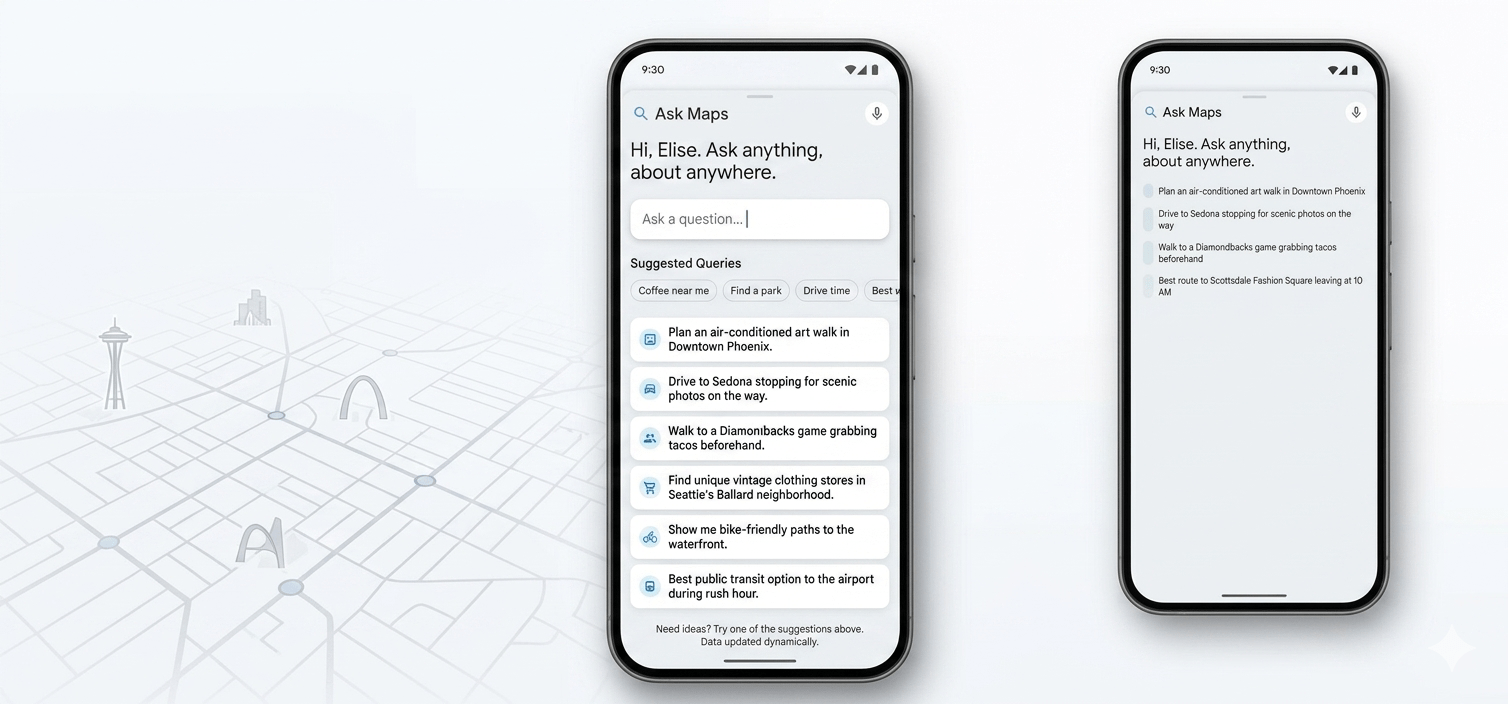
Google took the same AI that powers Search Overviews and put it directly inside the Maps app. It is called Ask Maps. Instead of typing keywords and getting a list, customers are now asking conversational questions and getting a single AI-generated recommendation with specific reasons why.
I need a water heater replaced next day. Who does brake jobs without an appointment in Bellevue? Find me a dentist that is good with anxious adults and has Saturday hours.
Google AI reads your reviews, your Google Business Profile, and your website. Then it decides if you are the right answer. Not the closest. Not the highest rated. The most specific match to what the customer asked.
A recent study of 350,000 business locations found that AI platforms recommend only 1 to 11% of businesses that appear in traditional search results. AI is skipping over 90% of businesses that already rank on Google.
You can be sitting at number two in the Map Pack and be completely invisible in Ask Maps. They are two different systems with two different winners.

The Fourth Ranking Signal: Attribute Match
For over a decade, local SEO has been built on three signals: proximity, relevance, and prominence. Every agency, every course, every local SEO guide has been built on these three. They still matter. But Google AI has added a fourth: Attribute Match.
Attribute Match means the AI is scanning your entire digital footprint looking for specific words and phrases that match what the customer asked. Not star ratings. Not keyword density. Actual language that describes a real experience.
The Seattle plumber with 400 reviews lost because his reviews are full of great service and highly recommend and five stars all the way. Glowing. Useless to the AI.
The plumber who won had a review that said next-day and water heater in the same sentence. The AI had something concrete to match against the customer question. That is the whole game now.
100 generic reviews are now worth less than 10 reviews that describe a specific experience.
The Four Levers of Ask Maps Optimization
1. Change How You Ask for Reviews
Stop asking customers to leave a review. That prompt produces exactly the kind of generic praise that AI cannot use.
Instead, ask them to describe what happened. Would you mind sharing what we fixed and how it went?
That shift produces reviews like: They replaced our 40-gallon water heater in Ballard in under three hours, showed up on time and hauled the old one away. Or: Called Tuesday morning, new unit installed by Wednesday noon. Or: Marcus found a leak in the supply line we did not even know about and fixed that too.
Technician name. Specific part. Timeline. Neighborhood. Every detail is an attribute the AI can match against a future customer question. This is why review strategy is now a core part of GBP optimization, not an afterthought.
2. Build Out Your GBP Completely
Most Google Business Profiles list three or four services when they should list twenty or thirty. That was always a missed opportunity. Now it is actively costing you visibility in a new discovery channel.
Every service needs a real description, not just a label. Not water heater repair. Write: Water heater repair and replacement for tank and tankless systems, same-day and next-day service available throughout Seattle and surrounding areas.
Every attribute checkbox. Every Q and A answered. Every section filled with specific searchable language. Thin profiles are invisible to AI. There is no middle ground anymore.
3. Build Your Website for Attribute Match
Ask Maps does not just read your GBP. It crawls your website looking for attributes to match against. If your homepage says we do plumbing, you are invisible for anything specific.
You need individual pages for every service you offer, and those pages need real descriptions. Response time. Service areas. What the process looks like. What customers can expect.
This is the foundation of AI Local SEO: building a website that gives AI systems enough specific matchable content to confidently recommend you across dozens of different customer queries.
4. Treat Google Posts Like Attribute Signals
Google Posts are indexable. The AI reads them. Every post is a chance to put specific matchable language in front of the AI.
Post about Saturday availability. Post about next-day service. Post about the specific neighborhoods you serve and the specific problems you solve. Most businesses treat posts like a chore. Start treating them like signals. Every post feeds the machine with more attributes to match.

5. We Asked Ask Maps How to Optimize Ask Maps
We went straight to the source. We asked Google’s new Ask Maps AI what local businesses should do to get recommended. Here is what it told us — translated into plain language for a business owner, not a tech person.
Change your review ask — and be specific about what you want customers to mention. Instead of asking customers to leave a review, ask them to describe the experience. Try: Would you mind sharing what we worked on and how it went? Or get even more specific: Tell us what you liked about our same-day service or our technicians. The more specific the review, the more attributes Ask Maps has to match against future customer questions. A review that mentions your technician by name, the specific job, and the neighborhood is worth ten times more than five stars and a smiley face.
Use your review responses to confirm your best attributes. This one surprises most business owners. When you reply to a review, the AI reads that too — and it treats your response as official business data. So if a customer says great service and you reply Thanks for trusting us with your tankless water heater installation in Fremont, you have just added tankless water heater installation and Fremont as indexable attributes. Think of it as a confirmation technique: the customer provides the evidence, you confirm and expand it. One caution — do not claim attributes in your responses that customers never mention. If reviewers say your shop is noisy but you keep calling it quiet in responses, the AI notices the contradiction and trusts you less.
If a feature is never mentioned in reviews, make it a Google Post or FAQ. Say you offer next-day service but none of your reviews mention it yet. Write a Google Post that says it plainly: We offer same-day and next-day water heater replacement throughout Seattle and the Eastside. Or add it to your website FAQ. This gives Ask Maps a second source to confirm what you offer — and two sources are always more credible than one.
Put your neighborhood and nearby landmarks on your website. Ask Maps thinks hyper-locally. If someone asks where can I get my water heater replaced near Green Lake, the AI looks for businesses whose websites mention Green Lake, Fremont, Phinney Ridge, or other nearby neighborhoods. If your website only says Seattle, you are invisible for those neighborhood-level searches. Add a service areas section to your site that mentions the actual neighborhoods and communities you serve — not just the city.
Ask your best customers to Save your business in Google Maps. Most business owners have never heard of this and it is completely free. When a customer saves or favorites your business in Maps, it sends a behavioral signal to Google that your business is relevant and worth remembering. Ask them directly: If we took good care of you, would you mind saving our business in Google Maps? It takes five seconds and it helps people in your situation find us. Small ask. Real impact.
What Ask Maps Optimization Means for Your Business Right Now
Google just put a filter on top of the Map Pack. If your digital footprint does not contain the specific language that describes what a customer is asking for, the AI skips you regardless of your star rating, your proximity, or how long you have been in business.
The Seattle plumber with five stars lost to a competitor with a 4.2 because one review had the right words in it. That is the new reality.
The businesses that figure this out in the next 90 days will own their markets. Their competitors will spend years wondering why call volume dropped.
This is a fundamentally different kind of local search optimization, one built around proving to AI that you are the specific, detailed, credible answer to what your customers are actually asking.
The window is open right now. Most of your competitors have not seen this yet.
Most Small Business Owners Cannot Do Ask Maps Optimization Alone
Understanding that attribute match exists is one thing. Systematically building it into your reviews, your GBP, your website, and your posts is another. Most small business owners are running their business. They do not have time to audit 30 GBP service descriptions, rewrite website pages for every service they offer, coach every customer on how to leave a useful review, and post weekly signals to feed an AI system they just learned about five minutes ago. This is exactly what AI Local SEO is built for. Not the traditional SEO playbook of citations and backlinks. Not keyword stuffing. A comprehensive, systematic approach to making sure every corner of your digital footprint speaks the specific language that AI systems like Ask Maps are listening for. That means building out your GBP completely. Creating service pages with real descriptions. Developing a review strategy that produces the specific, detailed feedback AI can actually use. Publishing Google Posts that double as attribute signals. And doing all of it consistently, month after month, so that when a homeowner in Shoreline taps Ask Maps at 9pm looking for next-day water heater service, your name is the one that comes up.
The businesses getting recommended by AI right now did not get there by accident. They got there because their entire digital presence was built to answer the exact questions their customers are asking. That is what our local SEO services are designed to do. Want to know if your business is showing up in Ask Maps and what it would take to get recommended? Book a free discovery call and we will show you exactly where you stand.


