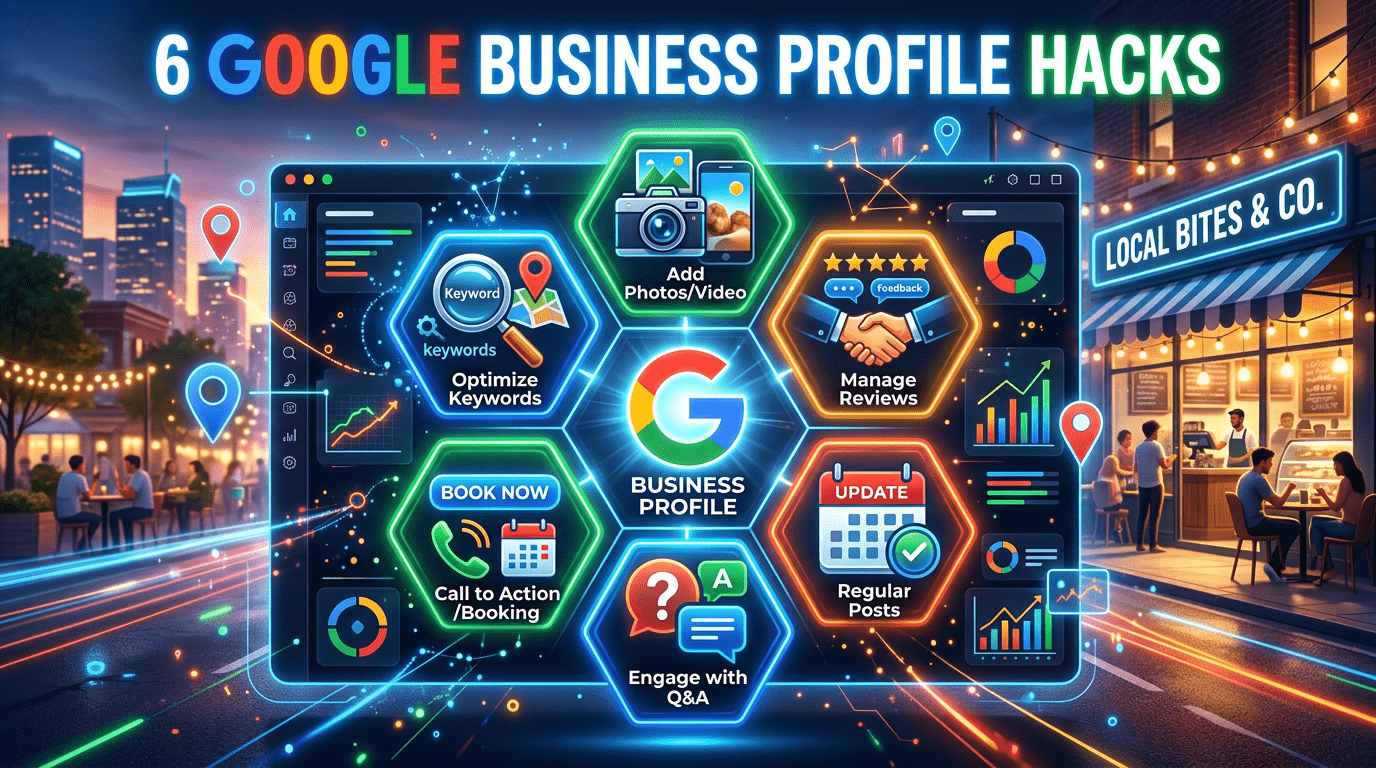

Google just released its first-ever official Google Business Profile Playbooks — a set of guides telling local businesses exactly how to optimize their profiles.
There’s a general playbook, plus industry-specific versions for restaurants, hotels, tours, and service businesses. If you’re a personal injury attorney, the service business playbook is the one that applies to you.
Here’s the short version of what Google says — and then the longer version of what actually moves the needle for personal injury law firms competing in AI search today. Because Google’s checklist gets you to the starting line. Winning the race takes more.
What Google Says Every Business Should Do
According to the new playbooks, these seven things are non-negotiable regardless of what industry you’re in:
- Keep your business information accurate. Name, address, phone, website — every field, always current. 91% of consumers search online before visiting a local business. For attorneys, most clients research extensively before calling. Accurate information is table stakes.
- Choose the right business categories. Your primary category is the single most powerful local ranking factor. “Personal Injury Attorney” should be your primary — then add secondary categories for car accident attorney, slip and fall attorney, or workers compensation attorney as applicable.
- Add photos and videos. Businesses with photos get 42% more direction requests and 35% more website clicks than those without. For law firms, professional photos of your attorneys, office, and team build the credibility that makes someone pick up the phone.
- Create Google Posts. Regular posts signal to Google that your business is active. One study showed adding Google Posts drove a +31% increase in Google Map Views.
- Add your social profiles. Google is actively pulling content from connected social accounts and displaying it in search results. If your profiles aren’t linked, Google can’t use that content for you.
- Add chat links. 67% of people prefer messaging a business over calling or emailing. Injured clients may be hesitant to call. A chat option lowers the barrier to first contact significantly.
- Manage and respond to reviews. 91% of consumers use reviews to evaluate local businesses. 65% say they’re more likely to choose a business that responds. For law firms, review responses demonstrate professionalism and care — always respond, always thoughtfully.

What Google Says Service Businesses (Like Law Firms) Should Do Beyond That
The service business playbook adds six more items specifically for businesses like yours:
- Write a business description. Front-load your practice areas, who you represent, and your approach. AI systems read this to understand your firm — generic copy hurts you.
- Keep hours accurate. 96% of customers are more likely to visit a business that clearly displays hours. If you offer after-hours consultations, note that explicitly.
- Set your service area. Personal injury cases often involve clients across a wide region. List every county and community you serve.
- Add business attributes. “Free consultation,” “no fee unless you win,” “Spanish-speaking staff” — these are high-search attributes that anxious injury victims specifically look for.
- Keep your service list updated. A personal injury firm that lists car accidents, truck accidents, slip and fall, workers compensation, medical malpractice, and wrongful death is a much broader AI search target than one that just lists “personal injury.”
- Accept bookings and appointments. 77% of consumers expect to book services online. A free consultation booking link makes the first step as easy as possible for an injured client.
The Muzes AI GBP Checklist for Personal Injury Attorneys: Going Beyond Google’s Baseline
Google’s playbook gets you optimized. This is what gets you recommended by AI.
☑ Put your case types in your photo captions. Open your office and attorney photos in Canva and add descriptive text: “Personal injury law firm in Bellingham WA — car accident and slip and fall cases.” AI systems read text on images. Professional headshots with context are worth significantly more than headshots alone.
☑ Build review content around case type and the client experience. Note: never encourage reviews that reveal case outcomes or confidential details. Instead, coach clients to describe the experience — how you communicated, how you guided them through the process, how supported they felt. A review that says “went through a serious car accident claim and [Attorney Name] made the whole process understandable and less stressful in Whatcom County” is exactly what AI looks for.
☑ Post educational content as Google Posts. “What to do after a car accident in Washington State” or “How long does a personal injury claim take?” These Posts demonstrate expertise, signal topical authority to AI systems, and attract clients who are in the research phase of finding an attorney.
☑ List every practice area with a brief description. Don’t just list “car accidents.” Write: “Car accident injury claims — representing injured drivers, passengers, cyclists, and pedestrians throughout Western Washington.” Specificity is what AI matches to specific searches.
☑ Link every active social account. If you share legal education content or firm updates on LinkedIn or Facebook, connect those accounts. Google is actively pulling social content into search results for connected profiles.
☑ Make free consultation and no-fee guarantee prominent everywhere. These attributes are among the most-searched for personal injury attorneys. They belong in your description, your Posts, and your service listings — not just checked as an attribute.

What Matters Most for AI Search Visibility
Your GBP feeds AI search systems like Google’s AI Overview and ChatGPT with structured data about your firm. The more complete, current, and content-rich your profile, the more confidently those systems recommend you.
For personal injury attorneys specifically, the highest-value AI signals are:
E-E-A-T signals throughout your profile. Personal injury is a YMYL (your money, your life) category — AI systems apply higher standards of evidence before recommending businesses in this space. Your credentials, years of experience, case types, and client outcomes (where permissible) all need to be clearly visible.
Case-type specificity across all practice areas. Searches for “car accident attorney,” “truck accident lawyer,” and “slip and fall attorney” are distinct queries. Your profile, service listings, and review content all need to address each one specifically.
Review content about the client support experience. AI evaluates review language for evidence of trustworthiness, communication, and genuine client care — critical signals when someone is searching for legal help at a vulnerable moment.
Profile freshness. Regularly updated GBPs earn 5x more reviews. Activity signals — new Posts, new reviews, updated service listings — tell AI your firm is actively practicing.
This is why GBP optimization for personal injury attorneys isn’t a one-time setup. Want to go deeper on the full AI search picture? Read How to Do AI Local SEO for Personal Injury Lawyers — or book a free discovery call and we’ll show you exactly where you stand.